If you drive the 405 through South Bay every day, you already know. Some stretches just feel wrong. The traffic stacks up at certain interchanges. Trucks merge aggressively at specific entrances. Visibility drops at particular curves. And the news keeps showing the same names: Gardena, Torrance, Carson, when another fatal pile-up shuts down the freeway.
That’s not a coincidence. The 405 through South Bay has documented patterns of multi-vehicle catastrophic accidents that other stretches of LA freeways don’t have. Below are the deadliest stretches, why they’re so dangerous, and exactly what to do if you’re in a crash on one of them.
Why the 405 Through South Bay Is Different
The Interstate 405 carries roughly 379,000 vehicles per day through Los Angeles County. The South Bay segment, running from roughly LAX down through Gardena, Torrance, and into Carson, combines several risk factors most freeways don’t carry simultaneously:
- Heavy commuter traffic stacking up during rush hours
- Significant commercial truck volume heading to and from the Port of Los Angeles and Port of Long Beach
- Multiple major freeway interchanges (105, 110, 91) creating high-frequency merge conflicts
- Aging infrastructure with limited shoulder space at key points
- Weather conditions where coastal fog rolls inland and reduces visibility
The result is a freeway where small mistakes cascade into multi-vehicle accidents at a higher rate than in other Southern California corridors.
Stretch #1: Gardena, Documented Fatal Multi-Vehicle Crashes
The 405 through Gardena has been the site of multiple high-profile fatal accidents covered by ABC7, CBS Los Angeles, and NBC Los Angeles. Notable incidents include a multi-car pile-up that killed a 19-year-old woman and injured two others, and a 5-car crash involving a cement truck that flipped multiple vehicles and shut down the freeway for hours.
These weren’t isolated events. The Gardena stretch sees recurring multi-vehicle pile-ups because of the combination of merge volume from Western Avenue and Crenshaw Boulevard, heavy commercial truck traffic from the ports, and the way commuter traffic stacks during peak hours. When something goes wrong in this stretch, the geometry of the freeway tends to cascade the impact into multiple vehicles rather than one.
Stretch #2: Torrance, Hawthorne Blvd and 190th St Interchanges
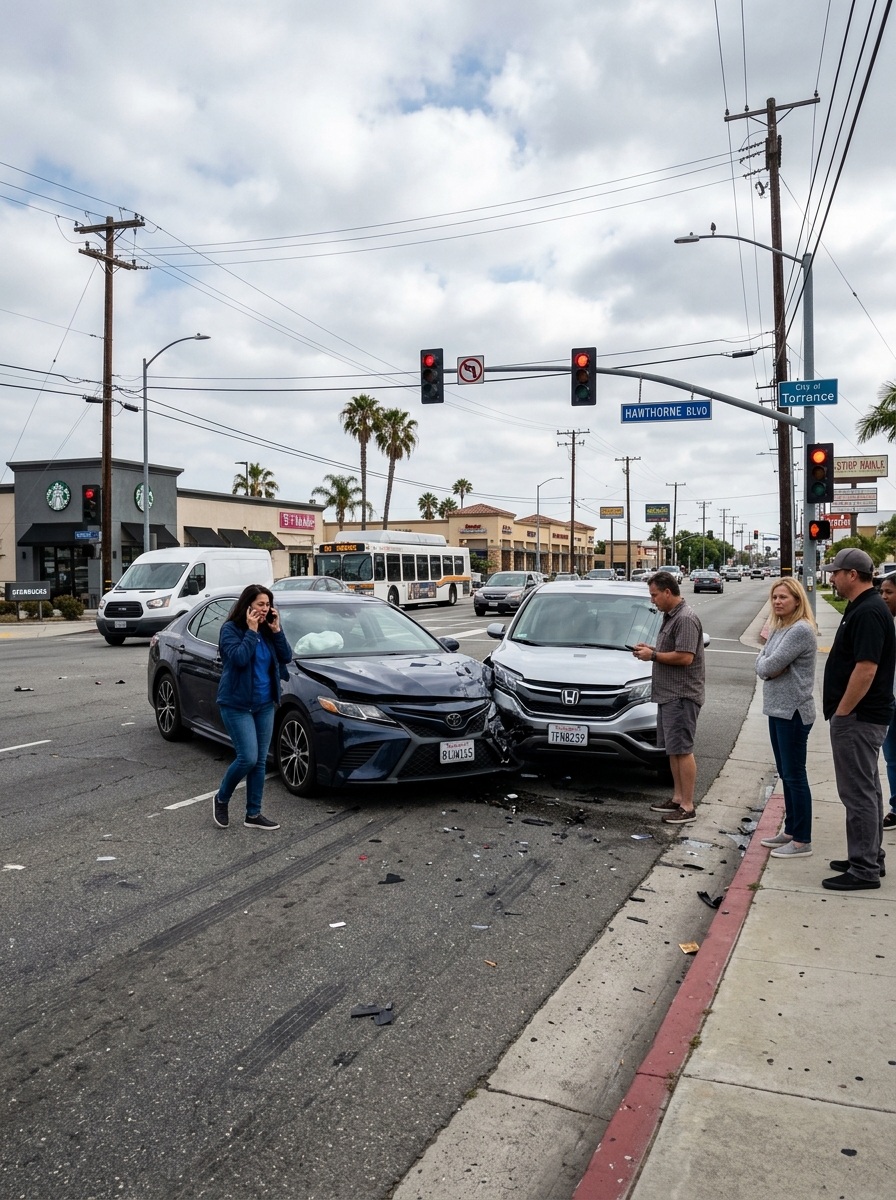
The 405 through Torrance carries some of the heaviest commute traffic in the South Bay, with major interchanges at Hawthorne Boulevard and 190th Street where surface-street traffic feeds onto the freeway. Both intersections are documented high-frequency collision zones.
The 190th Street interchange is particularly notorious for rear-end collisions caused by sudden slow-downs as traffic merges. Drivers heading to or from Manhattan Beach, El Segundo, and the Torrance industrial corridor experience daily congestion patterns that produce the kind of stop-and-go conditions where serious accidents happen.
Stretch #3: Carson, Where 405, 110, and 91 Converge
Carson sits at the convergence of three major freeways: the 405, the 110, and the 91. The interchange area is structurally complex, with lane changes required across multiple freeways within short distances. Add in the port-truck traffic moving through this segment, and you have a stretch where merging errors and lane-change accidents happen with disproportionate frequency.
The Carson stretch also produces a high volume of truck-involved accidents specifically because of the port traffic. When a fully loaded commercial truck hits a passenger vehicle at freeway speeds, the injuries are almost always catastrophic.
Why Multi-Vehicle Pile-Ups Are Legally Complex
A two-car accident with clear liability is relatively straightforward. A six-car pile-up on the 405 is not. California uses pure comparative fault, which means each driver can be assigned a percentage of responsibility for the accident. When multiple drivers are involved, the question of who pays what gets contested intensely.
Insurance companies for each driver will work aggressively to shift blame onto other drivers, including you. Your percentage of fault directly reduces your settlement. If you’re found 30 percent at fault, your award drops by 30 percent. Inflating your fault percentage is one of the most common insurance tactics in multi-vehicle freeway cases.
The Role of Commercial Trucks in 405 Pile-Ups
When a commercial truck is involved in a 405 pile-up, the legal complexity multiplies. Federal Motor Carrier Safety Administration regulations apply alongside California state law. Multiple parties can be liable: the driver, the carrier, the cargo owner, the broker, and sometimes even the manufacturer if equipment failure was involved.
Truck cases also involve dramatically larger insurance policies, often in the $1 million plus range per occurrence. That’s both an opportunity (higher available coverage) and a complication (the carrier’s defense lawyers will fight harder because the exposure is bigger).
What CHP Does at the Scene (and Why Their Report Matters)
The California Highway Patrol investigates every freeway accident on the 405. Their report becomes a foundational document in any subsequent personal injury case. It documents who CHP determined was at fault, what statements were made at the scene, what physical evidence was collected, and what citations (if any) were issued.
The CHP report typically takes 7 to 21 days to be released to involved parties. Insurance companies often have access to preliminary findings sooner than victims do, which gives them a head start on building their narrative of the accident.
Single-Vehicle vs. Multi-Vehicle 405 Accident: How Cases Differ
| Single-Vehicle Crash | Multi-Vehicle 405 Pile-Up |
| Clear liability between two drivers | Liability contested across multiple drivers and insurers |
| One insurance carrier involved | Often 3-7 carriers, each fighting to shift blame |
| Settlement timeline 6-12 months typical | 12-24+ months common due to complexity |
| Standard evidence preservation works | Requires immediate scene reconstruction and witness identification |
| Comparative fault straightforward | Comparative fault contested aggressively |
| Recovery from one policy | Recovery often pieced together from multiple policies |
What to Do at the Scene of a 405 Pile-Up: The 5-Step Playbook
- Get safe first. If you can move to the shoulder safely, do it. If the vehicle won’t move, stay belted until first responders arrive.
- Call 911. Even if it seems someone else has already called, your call documents your time and location.
- Photograph everything. Vehicle positions before they’re moved. Road conditions. Skid marks. Damage to your car and others. The number of vehicles involved. License plates of every visible vehicle.
- Get witness contact information. Names and phone numbers of anyone who saw what happened, before CHP releases everyone from the scene.
- Refuse to give recorded statements to any insurance company at the scene, including your own. Get medical attention, then call a personal injury lawyer before anything else.
How Lawyer Vince Handles Multi-Vehicle 405 Cases
In one case Lawyer Vince represented, a client was involved in a multi-vehicle pile-up caused by a distracted driver on the 405 near Torrance. The case resulted in a $2,650,000 settlement on behalf of the injured client. Past results do not guarantee future outcomes. Each case is unique and results vary based on the specific facts and circumstances.
What that case required: immediate scene reconstruction, identification and depositions of every involved driver, coordination with multiple insurance carriers, and aggressive challenge to fault-shifting tactics. That’s the kind of work multi-vehicle 405 cases demand. It’s also the kind of work most settlement-mill firms aren’t equipped to do well.
“Multi-vehicle freeway crashes are where insurance companies make their money, by shifting fault between drivers until everyone’s recovery shrinks. We don’t let that happen. We pin liability where it belongs and build evidence to prove it.”* , Vince Xu
Frequently Asked Questions
What should I do immediately after a 405 freeway accident?
Get to safety, call 911, photograph everything, collect witness contact information, refuse recorded statements to any insurance company, and call a personal injury lawyer before saying anything substantive about how the accident happened. Evidence on freeway crashes disappears fast. Witnesses scatter, vehicles get towed, and surveillance footage from nearby businesses gets overwritten within days.
Who is at fault in a multi-vehicle 405 pile-up?
It depends on how the accident developed. Sometimes one driver triggers the entire pile-up and bears most of the fault. Other times, multiple drivers contributed through following too closely, speeding, or distraction. California’s pure comparative fault rule means each driver gets assigned a percentage. The investigation matters enormously because percentages directly determine each victim’s recovery.
What if a commercial truck was involved?
Truck-involved cases are legally different from car-only cases. Federal regulations apply, insurance policies are larger, and multiple parties can be sued, including the trucking company, the cargo owner, and sometimes the broker. Evidence preservation is critical because trucking companies often try to repair or remove damaged vehicles quickly. A lawyer with truck accident experience should be involved within days, not weeks.
How long does CHP take to release the accident report?
Typically 7 to 21 days for the formal report. Preliminary information may be available sooner, but insurance companies often have access to internal information through their network before victims see the official document. Don’t wait on CHP to take action. Your lawyer can begin investigation immediately.
Can I sue multiple drivers in one lawsuit?
Yes. California civil procedure allows joining multiple defendants when their actions contributed to the same incident. In multi-vehicle cases, this is standard practice. It also means your case becomes more complex, with multiple defense lawyers fighting for their clients’ positions simultaneously.
What if I was partially at fault?
You can still recover damages in California, but your recovery is reduced by your percentage of fault. If you were 25 percent at fault, your award is reduced by 25 percent. The insurance companies will work to inflate your fault percentage as much as possible. A lawyer’s job is to keep your percentage as low as the evidence supports.
In a 405 Crash? Call Before You Talk to the Insurance Company
Free consultation. No fees unless we win. 24/7 in English, Spanish, Tagalog, and Mandarin. Lawyer Vince represents accident victims across Torrance, Long Beach, Carson, Gardena, and all of California.
Call (310) 861-4537 right now. Evidence on freeway crashes disappears fast. Don’t wait.
Past results do not guarantee future outcomes. Each case is unique and results vary based on the specific facts and circumstances. No attorney-client relationship is created until a formal agreement is signed.
Related Reading
- California Pure Comparative Fault: How It Works (And How Insurance Companies Exploit It)
- Gardena Personal Injury Lawyer: 405 Freeway Accident Specialist
- Port Truck Accidents in San Pedro and Wilmington: Why They’re Legally Different