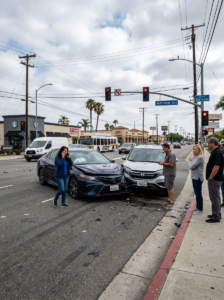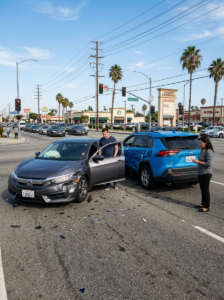
There’s a question most accident victims never think to ask. Which side of the courtroom has your lawyer worked on?
Most personal injury attorneys have only ever sat in one chair. They graduated law school, joined a plaintiff’s firm, and have spent their entire career representing injury victims. That experience matters. It teaches advocacy, trial strategy, and client communication.
But it has a blind spot. They’ve never been the lawyer the insurance company calls when a claim gets serious. They’ve never sat in a defense strategy meeting. They’ve never read the internal training documents that teach adjusters how to lowball injured victims. They guess at how the other side thinks.
I don’t guess. I worked there. And now I use every single thing I learned against them.
The Lawyer Vince Origin Story
I graduated with honors from Loyola Law School in Los Angeles, where I served as Production Editor of the Law Review, made the Dean’s List, and was awarded Best Negotiator on Loyola’s Transactional Negotiation Team. While in law school, I represented Loyola at the XXVI Willem C. Vis International Commercial Arbitration Moot, arguing before panels in San Diego, Kuala Lumpur, and Hong Kong. I also served as a Federal Court Judicial Extern for the Honorable Catherine E. Bauer in the U.S. Central District of California.
When I started practicing, I went to the defense side. Not because I believed in defending insurance companies, but because I wanted to understand how the system actually works.
For my first years in practice, I defended insurance carriers against personal injury claims filed by injured victims. I learned the playbook from the inside. I saw how reserves get set. I watched how settlement authority works internally. I read the training materials adjusters use. I observed which plaintiff’s lawyers got results and which ones got rolled over.
Then I pivoted. I joined Pasich LLP, where I represented policyholders against insurance companies in 7, 8, and 9-figure bad-faith lawsuits. Here, I learned every trick insurance companies use to wrongfully deny coverage, and I learned exactly how to break those tricks in court.
After that, I joined Lem Garcia Law as a personal injury attorney, where I spent nearly five years representing accident victims and refining my craft on the plaintiff side. In 2025, I opened Lawyer Vince.
Every step of that journey was deliberate. The defense-side experience. The bad-faith litigation. The plaintiff-side refinement. The point was never to defend insurance companies. It was to learn how they fight, so I could fight back better than anyone else representing victims.
What Insurance Defense Lawyers Actually Do
Here’s the truth, free of marketing language. Insurance defense lawyers are hired by insurance companies to minimize what the company pays out on claims. That’s the job. Everything else, the “thorough investigation,” the “fair evaluation,” the “good faith negotiation,” operates within that primary objective.
Defense lawyers learn to spot weaknesses in plaintiff cases. They learn which medical records tell the strongest story and which ones cast doubt. They learn how to make small inconsistencies in a victim’s account look like dishonesty. They learn the language adjusters use when they want to signal “this case is worth more than we’re offering” versus “this case isn’t going anywhere.”
That knowledge doesn’t disappear when you switch sides. It compounds. Every defense-side case I worked on taught me how the other team thinks, prepares, and reacts. I use that knowledge every day for my clients.
Tactic Insider #1: How Carriers Decide What to Offer
Every claim filed against an insurance carrier gets evaluated for a “reserve,” which is the amount of money the company sets aside internally to pay the claim. That reserve is the actual ceiling of what they’re willing to pay. The first offer to you is always a fraction of the reserve.
Adjusters are trained to start low and only raise the offer when specific signals appear: aggressive legal representation, clear evidence preservation, documented severe injuries, and a credible threat of litigation. Without those signals, the offer stays low, sometimes forever.
A former defense lawyer knows which signals matter and how to send them early. That’s the difference between settling for 30 percent of your case’s value and settling for 90 percent of it.
Tactic Insider #2: The Internal Reserve System
Reserves aren’t fixed. They get revisited as new information comes in. Strong medical documentation can raise a reserve. A favorable accident reconstruction report can raise a reserve. A demand letter that demonstrates the lawyer understands the carrier’s exposure can raise a reserve.
Most plaintiff’s lawyers don’t write demand letters that touch the reserve. They write demand letters that touch the adjuster’s initial impression. Those are not the same thing. A demand letter written by someone who knows how reserves are calculated can shift the entire negotiation in your favor before the adjuster even responds.
Tactic Insider #3: How Carriers Calculate “Reasonable” Settlements
Insurance companies have software. Colossus, Claims IQ, and similar programs assign values to injuries based on inputs the adjuster provides. The output is often described to victims as a “fair, objective” calculation. It is neither.
The output is only as honest as the inputs. Adjusters who want to keep settlements low will input minimum injury codes, exclude future treatment, undervalue lost wages, and skip pain-and-suffering modifiers. A former defense lawyer knows exactly which inputs got skipped, and how to force them back into the calculation.
The Bad-Faith Litigation Side: Where Insurance Companies Slip Up
When I represented policyholders against insurance companies in bad-faith cases, I saw the carriers from a third angle. Not as a defense lawyer working for them. Not as a plaintiff’s lawyer fighting them on a single claim. But as a litigator suing them for systematically violating their own policies.
That perspective taught me where insurance companies are most vulnerable: documented patterns of delay, low-ball offers below known case value, refusal to investigate claims fairly, and improper denial of coverage. When the right pressure gets applied at the right time, carriers fold quickly to avoid the discovery process exposing their internal procedures.
How This Experience Changes Case Strategy
Here’s what it looks like in practice. When a new client comes in with a fresh accident case, here’s the mental checklist running in the background.
| What Most Lawyers Do | What a Former Defense Lawyer Does |
| Send a generic demand letter when the case is “ready” | Send a strategically timed demand letter calibrated to the carrier’s reserve cycle |
| Wait for the adjuster’s first offer | Anticipate the first offer range and prepare the counter before it arrives |
| Argue case value based on jury verdicts | Argue case value based on the carrier’s own internal valuation methodology |
| Threaten litigation generically | Communicate specific bad-faith exposure if the case isn’t handled fairly |
| Settle for the offered amount when negotiation stalls | Know exactly when to walk and file suit to unlock higher offers |
Why Most PI Lawyers Don’t Know These Tactics
It’s simple. They’ve never been on the other side. The legal profession is largely siloed. Defense lawyers stay on defense. Plaintiff’s lawyers stay on plaintiff. Crossing over takes a specific career path that very few attorneys take.
Of the thousands of personal injury lawyers practicing in Southern California, only a small fraction started in insurance defense. Of those who started in defense, only a smaller fraction also have bad-faith litigation experience. The intersection of all three (defense, bad-faith, and now plaintiff work) is rare.
That intersection is the Lawyer Vince difference. It’s not marketing language. It’s a verifiable career path you can confirm on my LinkedIn, my California State Bar profile (#325053), and my published work in the New York Law Journal, Lexology, and Law360.
“I switched sides because I wanted to win for the right people. Now when an insurance company sees my name on a case, they know they’re not dealing with a stranger to their playbook. That changes the math on what they offer.”* , Vince Xu
Frequently Asked Questions
Did Vince really defend insurance companies?
Yes. Vince spent his early career at Yukevich Cavanaugh and Chapman Glucksman defending insurance carriers against personal injury claims. The career history is verifiable through his LinkedIn profile and through legal publications carrying his byline from that period. There’s no embellishment here. It’s a documented career path.
Why did he switch sides?
The defense work was never the destination. It was the apprenticeship. Vince wanted to understand how insurance companies operate from the inside before spending his career fighting them from the outside. Once he had that knowledge, he moved to policyholder representation and then to personal injury plaintiff work.
Does this experience actually make a difference in case outcomes?
Yes, in measurable ways. Insurance companies negotiate differently with lawyers they know have insider knowledge. Demand letters get taken more seriously. Reserve adjustments happen faster. Initial offers come in higher because the carrier knows the lawyer can articulate their internal valuation methodology back to them.
Do insurance companies treat former defense lawyers differently?
Yes. Adjusters are evaluated on closing claims quickly and cheaply. A claim handled by a lawyer the adjuster can’t easily roll over gets re-evaluated, escalated to supervisors, and often resolved at higher amounts to avoid the costs of litigation. That dynamic favors the client.
Where can I verify Vince’s career history?
The California State Bar website (apps.calbar.ca.gov) confirms his license status under #325053. His LinkedIn profile (linkedin.com/in/vincexu) details his complete career history. His published articles on insurance coverage litigation are searchable on the New York Law Journal, Lexology, and Law360.
How do I know this isn’t just marketing?
You don’t have to take Vince’s word for any of it. Every claim in this article is verifiable through public legal records, publication databases, and the California State Bar. The story isn’t designed to sell. It’s designed to prove a specific advantage that very few personal injury lawyers can credibly claim.
Hire the Lawyer the Insurance Companies Wish You Wouldn’t
Free consultation. No fees unless we win. 24/7 across Torrance, Long Beach, and all of California, in English, Spanish, Tagalog, and Mandarin.
Call (310) 861-4537 today. Find out what your case is actually worth from a lawyer who knows the other side’s playbook because he used to read it.
Past results do not guarantee future outcomes. Each case is unique and results vary based on the specific facts and circumstances. No attorney-client relationship is created until a formal agreement is signed.
Related Reading
- The 7 Insurance Company Tactics Every California Accident Victim Should Know
- Why Insurance Companies Lowball South Bay Accident Victims (And How to Make Them Pay)
- About Vince Xu, Personal Injury Attorney